Devotees Farms

by Chand Prasad, Ph.D

๐—ฆ๐—ง๐—”๐—ฅ๐—ง ๐—ช๐—œ๐—ง๐—› ๐—ฉ๐—˜๐—š๐—”๐—ก ๐—™๐—”๐—ฅ๐— ๐—ฆ

“๐ป๐‘’๐‘Ÿ๐‘’โ€™๐‘  ๐‘กโ„Ž๐‘’ ๐‘๐‘œ๐‘–๐‘›๐‘ก: ๐ผ๐‘†๐พ๐ถ๐‘‚๐‘ ๐‘๐‘œ๐‘Ÿ๐‘กโ„Ž ๐ด๐‘š๐‘’๐‘Ÿ๐‘–๐‘๐‘Ž๐‘› ๐‘“๐‘Ž๐‘Ÿ๐‘š ๐‘๐‘Ÿ๐‘œ๐‘—๐‘’๐‘๐‘ก๐‘  ๐‘Ž๐‘Ÿ๐‘’ ๐‘›๐‘œ๐‘ก ๐‘Ÿ๐‘’๐‘™๐‘’๐‘ฃ๐‘Ž๐‘›๐‘ก ๐‘ก๐‘œ ๐‘กโ„Ž๐‘’ ๐‘›๐‘’๐‘’๐‘‘๐‘  ๐‘œ๐‘“ ๐‘œ๐‘ข๐‘Ÿ ๐‘Š๐‘’๐‘ ๐‘ก๐‘’๐‘Ÿ๐‘› ๐‘๐‘’๐‘’๐‘Ÿ๐‘ . ๐‘Š๐‘’ ๐‘Ž๐‘Ÿ๐‘’ ๐‘›๐‘œ๐‘ก ๐‘š๐‘œ๐‘๐‘–๐‘™๐‘–๐‘ง๐‘’๐‘‘ ๐‘ก๐‘œ ๐‘๐‘Ÿ๐‘œ๐‘‘๐‘ข๐‘๐‘’ ๐‘“๐‘œ๐‘œ๐‘‘ ๐‘“๐‘Ÿ๐‘œ๐‘š ๐‘กโ„Ž๐‘’ โ„Ž๐‘Ž๐‘›๐‘‘๐‘  ๐‘œ๐‘“ ๐‘กโ„Ž๐‘’ ๐‘‘๐‘’๐‘ฃ๐‘œ๐‘ก๐‘’๐‘’๐‘ . ๐‘Š๐‘’ ๐‘Ž๐‘Ÿ๐‘’ ๐‘š๐‘œ๐‘๐‘–๐‘™๐‘–๐‘ง๐‘’๐‘‘ ๐‘ก๐‘œ ๐‘๐‘Ÿ๐‘œ๐‘‘๐‘ข๐‘๐‘’ ๐‘‘๐‘œ๐‘›๐‘Ž๐‘ก๐‘–๐‘œ๐‘›๐‘  ๐‘ฃ๐‘–๐‘Ž ๐‘กโ„Ž๐‘’ ๐‘Ž๐‘๐‘๐‘’๐‘Ž๐‘™ ๐‘œ๐‘“ ๐‘๐‘œ๐‘ค ๐‘๐‘Ÿ๐‘œ๐‘ก๐‘’๐‘๐‘ก๐‘–๐‘œ๐‘›, ๐ท๐‘’๐‘–๐‘ก๐‘ฆ ๐‘ค๐‘œ๐‘Ÿ๐‘ โ„Ž๐‘–๐‘ ๐‘Ž๐‘›๐‘‘ ๐‘กโ„Ž๐‘’ ๐‘คโ„Ž๐‘–๐‘Ÿ๐‘™๐‘ค๐‘–๐‘›๐‘‘ ๐‘๐‘ฆ๐‘๐‘™๐‘’ ๐‘œ๐‘“ ๐‘“๐‘’๐‘ ๐‘ก๐‘–๐‘ฃ๐‘Ž๐‘™๐‘  ๐‘Ž๐‘›๐‘‘ ๐‘‰๐‘Ž๐‘–๐‘ ๐‘›๐‘Ž๐‘ฃ๐‘Ž โ„Ž๐‘œ๐‘™๐‘ฆ ๐‘‘๐‘Ž๐‘ฆ๐‘ . ๐บ๐‘Ÿ๐‘œ๐‘ค๐‘–๐‘›๐‘” ๐‘Ž๐‘›๐‘‘ ๐‘‘๐‘–๐‘ ๐‘ก๐‘Ÿ๐‘–๐‘๐‘ข๐‘ก๐‘–๐‘›๐‘” ๐‘œ๐‘Ÿ๐‘”๐‘Ž๐‘›๐‘–๐‘ ๐‘“๐‘œ๐‘œ๐‘‘๐‘ โ€”๐‘Ž๐‘› ๐‘œ๐‘๐‘๐‘ข๐‘๐‘Ž๐‘ก๐‘–๐‘œ๐‘› ๐‘กโ„Ž๐‘Ž๐‘ก ๐‘๐‘œ๐‘ข๐‘™๐‘‘ ๐‘š๐‘Ž๐‘˜๐‘’ ๐‘ข๐‘  ๐‘ก๐‘œ๐‘ก๐‘Ž๐‘™๐‘™๐‘ฆ ๐‘Ÿ๐‘’๐‘™๐‘’๐‘ฃ๐‘Ž๐‘›๐‘ก ๐‘ก๐‘œ ๐‘œ๐‘ข๐‘Ÿ ๐‘›๐‘’๐‘–๐‘”โ„Ž๐‘๐‘œ๐‘Ÿ๐‘ โ€”๐‘–๐‘  ๐‘Ž๐‘› ๐‘ข๐‘›๐‘‘๐‘’๐‘Ÿ๐‘“๐‘ข๐‘›๐‘‘๐‘’๐‘‘, ๐‘ข๐‘›๐‘‘๐‘’๐‘Ÿ๐‘ ๐‘ก๐‘Ž๐‘“๐‘“๐‘’๐‘‘ ๐‘ ๐‘–๐‘‘๐‘’ ๐‘ โ„Ž๐‘œ๐‘ค.”โ€”โ€”Tapahpunja dasa in Cow Chauvinism: The Case for More Kale and Less Bull

๐…๐ฅ๐š๐ฐ๐ž๐ ๐Œ๐จ๐๐ž๐ฅ ๐จ๐Ÿ ๐€๐ ๐ซ๐ข๐œ๐ฎ๐ฅ๐ญ๐ฎ๐ซ๐ž

ISKCONโ€™s current idea of agriculture is strongly tied to building and solidifying its base of Hindu support. Rather than focusing on cultivating vegetables, tubers, and fruits, ISKCON prefers to attract donations from pious Hindus to support cow adoption and cow care programs. This type of virtue signaling mobilizes considerable sums of money. And it is not clear that the donations ISKCON receives are properly used. In any case, ISKCONโ€™s notion of agriculture is skewed and distorted because the institution seeks to extract money from Hindus. Furthermore, exploiting cows to get monetary donations violates Srila Prabhupadaโ€™s instructions on cow protection, as explained below.”

๐‘Š๐‘’ โ„Ž๐‘Ž๐‘ฃ๐‘’ ๐‘ก๐‘œ ๐‘˜๐‘’๐‘’๐‘ ๐‘ ๐‘œ๐‘š๐‘’ ๐‘๐‘œ๐‘ค๐‘ . ๐‘๐‘’๐‘ฃ๐‘’๐‘Ÿ ๐‘š๐‘–๐‘›๐‘‘ ๐‘ค๐‘’ ๐‘Ž๐‘Ÿ๐‘’ ๐‘ก๐‘œ ๐‘ก๐‘Ž๐‘˜๐‘’ ๐‘๐‘Ž๐‘ฆ๐‘š๐‘’๐‘›๐‘ก ๐‘“๐‘Ÿ๐‘œ๐‘š ๐‘œ๐‘กโ„Ž๐‘’๐‘Ÿ๐‘ . ๐‘‡โ„Ž๐‘Ž๐‘ก ๐‘–๐‘  ๐‘›๐‘œ๐‘ก ๐‘๐‘œ๐‘ค ๐‘๐‘Ÿ๐‘œ๐‘ก๐‘’๐‘๐‘ก๐‘–๐‘œ๐‘›. ๐ถ๐‘œ๐‘ค ๐‘๐‘Ÿ๐‘œ๐‘ก๐‘’๐‘๐‘ก๐‘–๐‘œ๐‘› ๐‘š๐‘’๐‘Ž๐‘›๐‘  ๐‘—๐‘ข๐‘ ๐‘ก ๐‘™๐‘–๐‘˜๐‘’ ๐ตโ„Ž๐‘Ž๐‘”๐‘Ž๐‘ฃ๐‘Ž๐‘›, ๐‘กโ„Ž๐‘’ ๐‘†๐‘ข๐‘๐‘Ÿ๐‘’๐‘š๐‘’ ๐‘ƒ๐‘’๐‘Ÿ๐‘ ๐‘œ๐‘›๐‘Ž๐‘™๐‘–๐‘ก๐‘ฆ ๐‘œ๐‘“ ๐บ๐‘œ๐‘‘โ„Ž๐‘’๐‘Ž๐‘‘, ๐ป๐‘’ ๐‘–๐‘  ๐‘ก๐‘’๐‘›๐‘‘๐‘–๐‘›๐‘” ๐‘กโ„Ž๐‘’ ๐‘๐‘œ๐‘ค๐‘ . ๐ป๐‘’ ๐‘–๐‘  ๐‘”๐‘œ๐‘–๐‘›๐‘”, ๐‘ก๐‘Ž๐‘˜๐‘–๐‘›๐‘” ๐‘กโ„Ž๐‘’ ๐‘๐‘œ๐‘ค๐‘  ๐‘๐‘’๐‘Ÿ๐‘ ๐‘œ๐‘›๐‘Ž๐‘™๐‘™๐‘ฆ ๐‘“๐‘Ÿ๐‘œ๐‘š ๐ป๐‘–๐‘  ๐‘Ÿ๐‘œ๐‘ฆ๐‘Ž๐‘™ ๐‘๐‘Ž๐‘™๐‘Ž๐‘๐‘’ ๐‘”๐‘œ๐‘–๐‘›๐‘” ๐‘ก๐‘œ ๐‘กโ„Ž๐‘’ ๐‘“๐‘œ๐‘Ÿ๐‘’๐‘ ๐‘ก ๐‘คโ„Ž๐‘œ๐‘™๐‘’ ๐‘‘๐‘Ž๐‘ฆ, ๐‘ค๐‘œ๐‘Ÿ๐‘˜๐‘–๐‘›๐‘” ๐‘กโ„Ž๐‘’๐‘Ÿ๐‘’. ๐ผ๐‘  ๐‘–๐‘ก ๐‘›๐‘œ๐‘ก, ๐‘๐‘œ๐‘คโ„Ž๐‘’๐‘Ÿ๐‘‘ ๐‘๐‘œ๐‘ฆ? ๐ด๐‘›๐‘‘ ๐‘ก๐‘Ž๐‘˜๐‘’๐‘› ๐‘ ๐‘œ๐‘š๐‘’ ๐‘™๐‘–๐‘ก๐‘ก๐‘™๐‘’ ๐‘“๐‘Ÿ๐‘ข๐‘–๐‘ก, ๐‘š๐‘œ๐‘กโ„Ž๐‘’๐‘Ÿ, ๐‘คโ„Ž๐‘Ž๐‘ก๐‘’๐‘ฃ๐‘’๐‘Ÿ ๐‘š๐‘œ๐‘กโ„Ž๐‘’๐‘Ÿ โ„Ž๐‘Ž๐‘  ๐‘”๐‘–๐‘ฃ๐‘’๐‘›. ๐‘‡โ„Ž๐‘’๐‘ฆ ๐‘Ž๐‘Ÿ๐‘’ ๐‘๐‘™๐‘Ž๐‘ฆ๐‘–๐‘›๐‘” ๐‘กโ„Ž๐‘Ž๐‘ก. ๐‘†๐‘œ ๐‘กโ„Ž๐‘–๐‘  ๐‘–๐‘  ๐‘๐‘œ๐‘ค ๐‘๐‘Ÿ๐‘œ๐‘ก๐‘’๐‘๐‘ก๐‘–๐‘œ๐‘›, ๐‘›๐‘œ๐‘ก ๐‘กโ„Ž๐‘Ž๐‘ก “๐‘†๐‘œ๐‘š๐‘’๐‘๐‘œ๐‘‘๐‘ฆ ๐‘ค๐‘–๐‘™๐‘™ ๐‘”๐‘–๐‘ฃ๐‘’ ๐‘š๐‘œ๐‘›๐‘’๐‘ฆ ๐‘Ž๐‘›๐‘‘ ๐‘ค๐‘’ ๐‘ โ„Ž๐‘Ž๐‘™๐‘™ ๐‘˜๐‘’๐‘’๐‘ ๐‘ ๐‘œ๐‘š๐‘’ ๐‘กโ„Ž๐‘–๐‘Ÿ๐‘‘ ๐‘๐‘™๐‘Ž๐‘ ๐‘  ๐‘๐‘œ๐‘ค๐‘  ๐‘Ž๐‘›๐‘‘ ๐‘“๐‘’๐‘’๐‘‘ ๐‘กโ„Ž๐‘’๐‘Ÿ๐‘’ ๐‘Ž๐‘›๐‘‘ ๐‘๐‘’๐‘๐‘œ๐‘š๐‘’ ๐‘๐‘œ๐‘ค ๐‘๐‘Ÿ๐‘œ๐‘ก๐‘’๐‘๐‘ก๐‘œ๐‘Ÿ.” ๐‘Š๐‘’ ๐‘š๐‘ข๐‘ ๐‘ก ๐‘ก๐‘’๐‘›๐‘‘ ๐‘กโ„Ž๐‘’ ๐‘๐‘œ๐‘ค๐‘  ๐‘ฃ๐‘’๐‘Ÿ๐‘ฆ ๐‘›๐‘–๐‘๐‘’๐‘™๐‘ฆ ๐‘ ๐‘œ ๐‘กโ„Ž๐‘Ž๐‘ก ๐‘กโ„Ž๐‘’๐‘ฆ ๐‘”๐‘–๐‘ฃ๐‘’ ๐‘ข๐‘  ๐‘ ๐‘ข๐‘“๐‘“๐‘–๐‘๐‘–๐‘’๐‘›๐‘ก ๐‘š๐‘–๐‘™๐‘˜. ๐ด๐‘›๐‘‘ ๐‘ค๐‘–๐‘กโ„Ž ๐‘กโ„Ž๐‘Ž๐‘ก ๐‘š๐‘–๐‘™๐‘˜ ๐‘ค๐‘’ ๐‘ โ„Ž๐‘Ž๐‘™๐‘™ ๐‘™๐‘–๐‘ฃ๐‘’.” [๐ฟ๐‘’๐‘๐‘ก๐‘ข๐‘Ÿ๐‘’ ๐‘œ๐‘› ๐‘†๐ต 2.9.3 – ๐‘€๐‘’๐‘™๐‘๐‘œ๐‘ข๐‘Ÿ๐‘›๐‘’, ๐ด๐‘๐‘Ÿ๐‘–๐‘™ 5, 1972]

Cows and bulls are valuable assets for farm communities. Moreover, cattle receive spiritual benefits when engaged in work that supports devotional activities. But to the detriment of both bovine and human temple residents, ISKCON has not been able to properly integrate cows into their economic systems.

๐‚๐จ๐ฐ ๐๐ซ๐จ๐ญ๐ž๐œ๐ญ๐ข๐จ๐ง

The underlying principle of cow protection is to employ bulls to work the land, implying that cows are bred only to the point where the cattle population meets the demand for draft power, rather than the demand for the byproducts, e.g., milk. In sharp contrast, raising cows for the purpose of producing milk is an egregious errorโ€”the cow will not produce milk unless it has calves, and since half will be male, the result is an excess livestock population that is costly to support. Farming practices that do not engage the bulls essentially condemn them to the slaughterhouse, since they will have no economic value other than their meat. After calibrating the growth of the herd to the demand for draft power, the byproducts such as manure, urine, and milk can be put to good use.

๐„๐ฑ๐œ๐ž๐ฌ๐ฌ๐ข๐ฏ๐ž ๐๐ซ๐ž๐ž๐๐ข๐ง๐ 

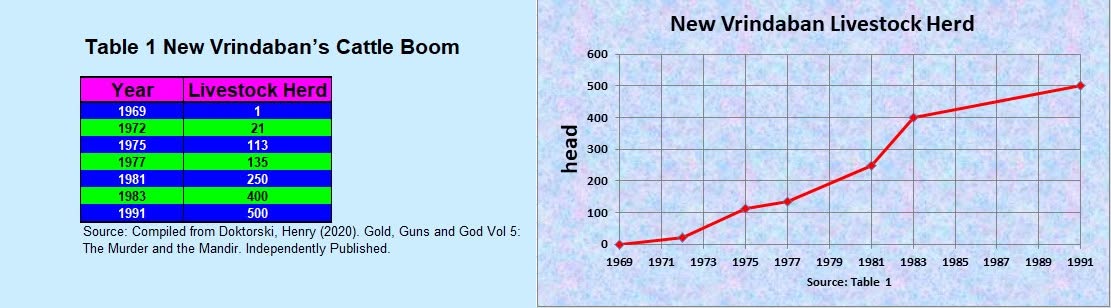
New Vrindaban is a prime example of what not to do. Kirtanananda dreamed of having the largest dairy farm in West Virginia, and for a time, that goal โ€œclearly seemed to have become a realityโ€ (GGG5 p. 137 Kindle Edition)โ€”in 1991 the livestock herd reportedly expanded to 500 head (including cows, oxen, and bulls), up from 400 in 1983 (Table 1).However, Kirtananandaโ€™s dream could not be sustained in the face of binding financial and land constraints, legal expenses, his insane obsession with building a magnificent Palace of Gold, and a few years later an enormous granite temple in South-Indian Dravidian style estimated to take fifteen years to construct.

๐‚๐š๐ซ๐ซ๐ฒ๐ข๐ง๐  ๐‚๐š๐ฉ๐š๐œ๐ข๐ญ๐ฒ

New Vrindaban does not have the internal resources to maintain a large livestock herd. Based on New Vrindabanโ€™s climate and soil, each cow requires about 6-10 acres of arable land, according to Madhava Gosh (ISCOWP News, 1998, Issue 1). The land requirement for a given herd, i.e. the carrying capacity, varies due to differences in local growing conditions, feeding practices, and the specific cow breed, e.g. Holstein versus Jersey cows. Carrying capacity falls sharply when the soil is not properly maintained. To avoid dramatic reductions in carrying capacity, lime must be applied to New Vrindabanโ€™s naturally acidic soil, and pastureland must be rotated to avoid overgrazing.Although the exact extent of New Vrindabanโ€™s carrying capacity may be debatable, the communityโ€™s farm managers did not even come close to properly incorporating land or even labor constraints into their decision-making. Please note the size of the agricultural labor force is also uncertain, as devotee farm hands can come and go. A great deal of New Vrindaban is forest, and not all of the non-forested land is arable. โ€œโ€ฆmuch of the land is too steep to be used even for grazing.โ€ (Madhava Gosh, ISCOWP News, 1998, Issue 1) โ€œDespite the communityโ€™s vast acreage, there was apparently not enough man power nor arable farmland to grow adequate feed for the animals. The goshala was not self sufficient; it could not survive without outside funding.โ€ (GGG5, p. 137 Kindle Edition) [bold, mine]In a letter to Kirtanananda dated June 24, 1969, Srila Prabhupada had requested โ€œ…that you try and keep as many cows as possible in your New Vrindabanโ€ (GGG5, p. 135, Kindle Edition). However, the key phrase is, โ€œas possible.โ€ The temple leaders must take responsibility for calculating what is possible. Krishna already providedโ€”He provided humans with a brain and higher intelligence, and those blessings should not be thrown away. ISKCON was intended to be decentralized with local temples wielding considerable autonomy. Each temple should make practical decisions based on an understanding of local conditions and constraints.

๐๐ซ๐š๐œ๐ญ๐ข๐œ๐š๐ฅ ๐Ž๐›๐ฌ๐ญ๐š๐œ๐ฅ๐ž๐ฌ

But let us forget about ISKCON for a moment or two. After all, I am humbly suggesting that ISKCON devotees walk away from the cult institution and consider forming their own preaching centers if that is their calling. Let us assume that these new preaching centers are managed by honest and wise leaders who have resolved not to make the mistake of breeding cows for milk, as Kirtanananda did. Instead, the enlightened leaders will breed cows for draft power. Unfortunately, even with honest leadership and the correct breeding strategy, in the short run, it is difficult for devotee farms to effectively employ draft animals. In the United States, only the tiniest number of people have the ability and temperament for engaging oxen in agricultural tasks. The human ox-handler must first become friends with the oxen, which can take a considerable amount of time. After establishing friendship and rapport, the teamster must teach the oxen to follow voice commands, rather than cruelly using a nose ring. Bovines are perceptive beasts. They can sense human impatience, frustration, and anger. The oxen will react by becoming stubborn. Few people can work with oxen in a continually respectful manner, always remembering the ox represents Dharma. It is a truly rare individual who can simultaneously cherish and utilize draft animals in farming without worrying about their financial situation or survival. Ox handlers rarely operate in economic settings that permit them to compassionately work with their draft animals at a measured, humane pace. And do not forget the reality of carrying capacity. Each cow requires several acres of land, as discussed earlier. Land purchases can be costlyโ€”even more so when financed with mortgage loans which create an additional layer of risk. A cow can live 20-25 years, and she must receive care and support even in old age. Eventually, the Vaishnava community might be forced to ask for donations to support its aging cow population. In that case, the devotee farm is no longer self-reliant.

๐๐ซ๐ž๐ฅ๐ข๐ฆ๐ข๐ง๐š๐ซ๐ฒ ๐’๐ญ๐š๐ ๐ž

Economic reasoning dictates that agricultural development begins with vegan farms. One study suggests that an adult vegan requires less than one acre of land to be self-sufficient in food for one year (https://www.selfsufficienthomesteading.com/). Obviously, this figure should be treated as a rough estimate. Different people require different amounts of food. Growing conditions are less favorable in some locations. Some gardeners are more skilled than others and/or have greater access to appropriate farming technologies. If every member of the devotee community is engaged in agriculture, then oxen are not needed. A healthy adult would not need petroleum-powered machinery or oxen to cultivate an acre of land that has already been cleared of vines, bushes, weeds, etc. Older farm tools that have long since been abandoned are still useful in non-commercial farming.

๐•๐ž๐๐ข๐œ ๐•๐ข๐ฅ๐ฅ๐š๐ ๐ž

However, a larger, more diverse community will require a class of teamsters that can work effectively with oxen. If the goal is to implement a varnashrama-dharma system, each farmer would need to support several non-farmers. That is to say, each farmer must be able to cultivate relatively large amounts of land to support the entire devotee village, and such agricultural productivity is only possible with the help of oxen. In a village setting, the advantages of cow protection are too compelling to ignore or forego. Draft animals can do a lot more than just tilling large areas and fertilizing the fields. Oxen can be engaged in hauling and transport, grinding seeds to produce oil, milling grain into flour, powering saws to cut wood for fuel, and operating water pumps. Interestingly enough, ox-driven electric generators also exist, although I recommend that the temples remain connected to the grid. It is easy to talk about all of the wonderful things that can be accomplished with male bovines, but nobody has the necessary skills to actually do them. Those skills can be learned. However, devotees, including Suresh Persaud, spend lots of time criticizing ISKCON while being slow to learn about the more technical aspects of agriculture.

๐…๐ข๐ง๐š๐ฅ ๐‘๐ž๐ฆ๐š๐ซ๐ค๐ฌ

If the goal is to start a vegan community in which each member is engaged in farming, then oxen are not necessary. Each devotee would cultivate relatively small vegetable plots using their own labor, without the need to produce surplus food for others. On the other hand, if the objective is to establish a Vedic Village, the farmers must be productive enough to produce surplus food to feed the rest of the community. Such agricultural productivity requires the use of oxen. Math and economics indicate that the varnashrama-dharma system cannot be separated from cow protection.
Toxic Freedom

by bhakta Eric Johanson

Superstorm Sandy

โ€œBut everyone wants sunshine. Why in one place denied, and one place there is sunshine? You are not free. Even though you want sunshine, there is no sunshine. So how you feel free? You bring sunshine. But that is not happening. There is superior arrangement. So to accept that superior arrangement, that is real business, not to declare freedom falsely. That is not possible. If I say: โ€˜I am free from the law-abiding process, law given by government. I am free from the law of the government,โ€™ that is not possible. If you become outlaw, then you will be arrested and put into jail. So what is the use of declaring that, โ€˜I am free from the government lawsโ€™? There is no freedom. Whatever little freedom is given to us, if you utilize it properly, that is very nice. If we unnecessarily declare that, โ€˜I am free from any obligation,โ€™ that is madman’s proposal. That is the mistake of the modern man, that especially in the Western countries, unnecessarily they are declaring freedom in so many ways.
Unnecessarily. He is not free, but he is declaring. That is described in Caitanya-caritฤmแน›ta, I think, or in some other. No? Prema-vivarta. Yes, there is a book, Prema-vivarta: piล›ฤcฤซ paile yena mati-cchanna haya/mฤyฤ-grasta jฤซvera se daล›ฤ upajฤya. The freedom is declared by persons who are completely under the clutches of mฤyฤ. He declares freedom. And he is so much haunted by the ghost mฤyฤ that he thinks his bondage as freedom. Just like a drug-addicted person or drunkard. He is thinking, โ€˜I am free.โ€™ He lies down on the street sometimes in madness: โ€˜Who can forbid me?โ€™ You have seen madmen lying on the street. I have seen it, all traffic stopped. So this kind of freedom has no meaning. It is involving oneself with the strict laws of mฤyฤ. There is no freedom. And just like a child, if he becomes free from the parents, it is not good; it is dangerous. His life is at risk. If a child without the help of the parents go on the street, is . . . that freedom is nice? That kind of freedom. Therefore Kแน›แนฃแน‡a says that โ€˜Whatever little freedom you have got, just surrender that freedom to Me.โ€™ Sarva-dharmฤn parityajya mฤm ekaแน ล›araแน‡aแน (BG 18.66).โ€ Room Conversation, July 26, 1975, Laguna Beach, emphasis added

Continue reading
This entry was posted on March 13, 2022. 1 Comment

Atmospheric Warming and U.S. Strategic Interests in South Asia

by Chand Prasad, Ph.D.

With the exception of the polar regions, the frozen Hindu Kush and Himalayan ranges contain more ice than anywhere else on Earth. The glaciers feed ten of the world’s most important river systems, including the Ganges, Indus, Yellow, Mekong and Irrawaddy, and directly or indirectly supply billions of people with food, energy, clean air and incomes. The Himalayan glaciers have been losing almost half a meter of ice each year since the start of this centuryโ€” double the amount of melting that occurred between 1975 and 2000.

Continue reading

Review of Gold, Guns and God: Volume 2–A Pioneer Community

by Chand Prasad, Ph.D.

Academic scholars will benefit from reading Gold, Guns and God: Volume 2โ€”A Pioneer Community (GGG Vol 2). Prabhupada disciples should be forewarned. GGG Vol 2 presents Prabhupada in an unjustifiably negative light.

Doktorski contributes to the literature with his (a) coverage of Kirtananandaโ€™s heretofore undocumented defection from ISKCON in September 1967 and his subsequent reunion with Prabhupada in July 1968; (b) insights into the inauspicious founding of New Vrindaban; (c) detailed information on the communityโ€™s expansion through the purchase of properties in the McCreary Ridge. Doktorski provides a valuable understanding of Kirtananandaโ€™s charisma, his extensive travels outside of West Virginia, and the separation that the New Vrindaban community felt when Kirtanananda was away. I have not found this information elsewhere.

Continue reading

Review of Gold, Guns, and God: Vol 1–A Crazy Man

by Chand Prasad, Ph.D.

Shrila Prabhupada did not timidly admit that ISKCON is a cult.ย  He boldly and repeatedly declared it.ย  How could anyone claim he did not know he joined a cult?ย  ISKCON likely started as a beneficial cult, then degenerated into a malevolent cult to the detriment of its members, both old and new.

Shrila Prabhupadaโ€™s stated objective is to preach the cult of bhakti.ย  The question that remains is Prabhupadaโ€™s role, if any, in imposing the undeniably harmful cult characteristics that are well documented in the literature on ISKCON. The addendum to Volume 1 of Gold, Guns, and God does not give a balanced, even-handed treatment of Prabhupadaโ€™s alleged complicity in the creation of a detrimental cult we know ISKCON to be.

Continue reading

Is Democracy Still Capable of Solving the World’s Problems? (or at least those of the U.S.)

by bhakta Eric Johanson

“Nowadays it is the days of vote. Any rascal, if he gets vote somehow or other, then he acquires the exalted post. That is also written in the Srimad-Bhagavatam, that in the Kali-yuga there will be no consideration who is fit to occupy the exalted post of presidentship or royal throne. Simply somehow or other, by hook and crook, heโ€™ll occupy the seat. Therefore people are suffering. It is notโ€ฆ Nowadays, in democratic days, the government by the people, government for the people. So if the government is by the people, yes, you select your representative. If you are a fool, then you will select another fool. So Bhagavata says, sva-vid-varaha ustra-kharaih samstutah purusah pasuh. Anyone who is not a devotee, Krsna conscious devotee of God, then he may be in a exalted post, but he is praised by some people who are exactly like sva. Sva means dog, and vid-varaha means pigs who eat stool. Sva-vid-varaha. Vid-varaha. And ustra, ustra means camel. And ustra-kharaih. Khara means ass. Sva-vid-varahostra-kharaih. If a person who is not a devotee, he is praised or he is exalted, then the praisers, the persons who is praising him, he must be among these animals: dog, camel, pig and ass. So the whole population is like that, like dog, like camel, like ass and like vid-varaha, pig, the stool-eater, the whole population, at the present moment. So he must elect another big animal who is also in this category. Because he has no knowledge.โ€ Lecture on Srimad-Bhagavatam 1.15.37 โ€” Los Angeles, December 15, 1973

Here Srila Prabhupada is describing the fundamental flaw of what is called democracy – people trained only in bodily sense gratification are incapable of electing someone who will see to their material and spiritual well being. This means that the problems facing such a society will rarely be improved. This is now fully on display in what is lauded as the world’s greatest democracy, the United States, in regard to the Coronavirus pandemic. This is not to say that all democracies have failed in regard to this plague, it is just that the factors just described by Srila Prabhupada are now wreaking havoc in the US. The same reasons are also found in the lack of a practical US solution to the climate change crisis.

Continue reading
This entry was posted on May 23, 2020. 5 Comments

How to Live on a Farm in the 21st Century

By:

Introduction

Towards the end of the Cow Culture Conference held in Kuala Lumpur on October 7, 2018, during the question-and-answer session, a devotee asked for practical advice on how to adopt a Vedic farm lifestyle. He wanted to know whether there are any model farms around the world that we could follow, and also what he, a city-dweller, could do if he were to live on a farm.

I was very happy he asked this question because it signalled to me that the devotee was keen to live simply according toย Dharma, and he wants to know more. That, to me, is the first step in a long but necessary journey back to a Vedic lifestyle based onย Varnasrama Dharma, which I believe is the only sustainable lifestyle for humanity.

Srila Prabhupada once said, โ€œUnless in the human society the Varnasrama system is introduced, no scheme or social order, health order or any order, political order, will be successful.โ€ Indeed, Srila Prabhupada stressed the importance of varnasrama dharma as he departed this world more than 40 years ago.[1]

Hence, I believe the question ought to be answered in a comprehensive manner, which speakers often cannot do at conferences due to time limitations. I am writing this article with the hope that the above question will be answered deservingly.

For a start, let me just briefly say that there are several existing Hare Krishna communities around the world that have established โ€œVedic villagesโ€ in their own way. Although we may aspire to live in an ideal Vedic village, I donโ€™t believe there is any one model that can be copied everywhere because the local conditions and culture in each country will present its own set of challenges and will require specific solutions. Continue reading

This entry was posted on January 26, 2020. 1 Comment

Climate Change and Agriculture

by Chand Prasad, Ph.D.

Agriculture accounts for close to 25% of global greenhouse gas emissions and 70 percent of all freshwater use. Agricultural related greenhouse gas emissions stem from the production of crops and animal products, as well as the conversion of forests, savannas, and peatlands to crop and pasture lands. The amount of land used for total agricultural production has grown at a rate of more than 10 million hectares per year since the 1960s. Agriculture employs roughly 2 billion of the planetโ€™s people and uses about one-half of vegetated land i.e., land that is not covered by ice, water, or desert [1]. Pastureland alone occupies 25% of the planetโ€™s land mass, excluding Antarctica [2]. Croplands and pasture lands have expanded at the expense of tropical forests.ย  The environmental impacts of agriculture will intensifyโ€”in the coming decades, billions of people will join the global middle class and adopt meat-centered diets, exacerbating land degradation, water shortages, and adverse effects from climate change [1].

The impacts of global warming are already apparent.ย  Greenland lost about 2 billion tons of ice in one day (June 13th, 2019).ย  Ice losses of this magnitude are part of a recent pattern. This extreme melting did not occur prior to the late 1990s.ย  Since then, however, Greenland experienced a a sequence of large melt seasonsโ€”2007, 2010, and 2012โ€”that would have been unprecedented earlier in the record. Barring any offsetting factors, if these periodic extreme melts become a regular occurrence, then this new normal would significantly contribute to rising global sea levels [3].

Continue reading

Global Warming and Geoengineering

by Chand Prasad, Ph.D.

Global warming poses a number of grave threats to agriculture, including the loss of pollen viability for some crop species at higher temperatures, more extreme unpredictable weather, and coastal flooding [1].ย  Any serious efforts to address climate change will necessitate the adoption of organic farming and the rejection of commercial agricultural systems that foster and serve the global meat culture.ย  However, rather than undertaking constructive and fundamental changes aimed at cutting greenhouse gas emissions, many in the scientific community have counseled an approach known as geoengineering, which is often described as technological interventions in the earthโ€™s climate systems to manipulate our weather and our oceans.ย  Unfortunately, this depiction of geoengineering is misleading, or at best incomplete.ย  Although global warming has been utilized as an argument for increased support and funding for environmental modification technologies, geoengineering is rooted to a large extent in its potential for military applications, which include creating weather disturbances that are destructive to enemy combatant nations [2].

The United States and the Soviet Union conducted some of the earliest geo-scale experiments and engineering efforts between 1958 and 1962.ย  These 2 Cold War combatants were attempting to modify the global environment for military purposes by detonating nuclear bombs in space โ€“ the goal of combating global warming played absolutely no role.ย  The 1958 U.S. Argus project, for instance, involved the use of A-bomb explosions in the Van Allen Belt (magnetic belts protecting the earth from the destructive solar windโ€™s charged particles) to create an artificial radiation belt, disrupt the near-space environment, and possibly intercept enemy missiles.ย  Project Argus, and later high altitude nuclear tests by the U.S. and the Soviet Union that followed, culminated in the 1962 Starfish Prime H-bomb space detonations that created an artificial electromagnetic radiation belt that remained for 10 years [2].ย  Project Starfish had a substantially disruptive impact on the Van Allen belt, altering its shape and intensity for approximately 100 years to come.ย  Geo-weaponry projects also included the 1962 U.S. military use of electronic beams to ionize and de-ionize areas of the atmosphere to generate artificial lightening, as well as a Canadian project that entailed launching satellites into the earthโ€™s ionosphere to chemically simulate plasma (an example of which is lightening) [3, 20].

In response to the destructive impacts of these activities, the United Nations General Assembly approved the 1976 Convention on the Prohibition of Military or Any Other Hostile Use of Environmental Modification Techniques [4].ย  However, the United Nations left a debilitating loophole โ€“ the Convention did not prohibit peaceful projects (Article III of Convention) such as pure research, solar energy projects, or industrial resource development.ย  This omission allowed countries to simply re-label or restate the objectives of their geo-warfare projects as, for instance, weather research aimed at increasing food production in the North American plains or in Russia [3]. Continue reading

Better Preaching Ahead

At some point every conditioned soul realizes the futility of material life. However, while there is still hope of sense gratification, most will strive to overcome each and every obstacle to it. This generally continues until just prior to the moment of death. At that point everyone starkly understands their utter defeat โ€“ everything they have worked for will be taken away, including their very conception of who they are. It is a rare soul who, understanding this inevitability, anticipates this dilemma and endeavors for that pleasure and realization that transcends the activities of the material body.

tasyaiva hetoh prayateta kovido/ na labhyate yad bhramatam upary adhah/ tal labhyate duhkhavad anyatah sukham/ kalena sarvatra gabhira-ramhasa – Persons who are actually intelligent and philosophically inclined should endeavor only for that purposeful end which is not obtainable even by wandering from the topmost planet down to the lowest planet. As far as happiness derived from sense enjoyment is concerned, it can be obtained automatically in course of time, just as in course of time we obtain miseries even though we do not desire them. Srimad Bhagavatam 1.5.18

That purposeful end is Krishna, or God, consciousness with complete knowledge of oneโ€™s constitutional position as sat, cit and ananda, or eternity, knowledge and bliss. There is, however, a very social component to oneโ€™s determination to, come hell or high water, continue striving for greater and greater sense pleasure. Virtually everyone takes on the values and goals of those around them, especially role models like parents. If one is raised in a family or society where self-realization is emphasized, such as Vedic culture, there is that much less chance they will devote themselves to bodily pursuits. Even most indigenous cultures stress non-material attainments.

This is not the case in Western society, or those which, in imitation, are shamelessly abandoning more restrained traditional lifestyles. In the West there is an entire sector of the economy, advertising, which strives to generate as much material desire as possible. Although not as crass, Western education is similarly materialistic and manipulating. Students are often browbeaten to accept โ€œscience-basedโ€ ideology where matter is dogmatically said to be all that exists. And the goal of every โ€œworthwhileโ€ course of study is to develop the career skills one needs to indenture themselves to one corporation or another for forty years. Even many adherents of the prominent Western religion, Christianity, believe that Godโ€™s favor is indicated by the level of oneโ€™s material success. Sayyid Qutb, an Egyptian scholar of the traditionalist Muslim Brotherhood, spent some time in the American Midwest shortly after World War II and later wrote:

โ€œAnd when humanity closes the windows to faith in religion, faith in art, and faith in spiritual values altogether, there remains no outlet for its energy to be expended except in the realm of applied science and labor, or to be dissipated in sensual pleasure. And this is where America has ended up after four hundred years.โ€ The America I Have Seen, Sayyid Qutb

Over the last hundred years Western culture has become exponentially hedonistic. The pre-60โ€™s America described by Qutb is now ironically considered prudish, repressive and Puritanical. This โ€œmodernโ€ period of the West was characterized by the belief that technology and capitalism were going to allow every generation to be more prosperous and carefree than the previous one โ€“ โ€œprogress.โ€ This conviction empowered most with the hope that anything was possible, and that Western culture was capable of overcoming anything standing in the way of both individual and collective sense pleasure. Many even believe that science will provide the โ€œsingularityโ€ that will enable them to avoid death. Why anyone would want to live eternally in Western society is nevertheless puzzling? Continue reading

This entry was posted on September 2, 2017. 7 Comments