by Chand Prasad, Ph.D
𝗦𝗧𝗔𝗥𝗧 𝗪𝗜𝗧𝗛 𝗩𝗘𝗚𝗔𝗡 𝗙𝗔𝗥𝗠𝗦
“𝐻𝑒𝑟𝑒’𝑠 𝑡ℎ𝑒 𝑝𝑜𝑖𝑛𝑡: 𝐼𝑆𝐾𝐶𝑂𝑁 𝑁𝑜𝑟𝑡ℎ 𝐴𝑚𝑒𝑟𝑖𝑐𝑎𝑛 𝑓𝑎𝑟𝑚 𝑝𝑟𝑜𝑗𝑒𝑐𝑡𝑠 𝑎𝑟𝑒 𝑛𝑜𝑡 𝑟𝑒𝑙𝑒𝑣𝑎𝑛𝑡 𝑡𝑜 𝑡ℎ𝑒 𝑛𝑒𝑒𝑑𝑠 𝑜𝑓 𝑜𝑢𝑟 𝑊𝑒𝑠𝑡𝑒𝑟𝑛 𝑝𝑒𝑒𝑟𝑠. 𝑊𝑒 𝑎𝑟𝑒 𝑛𝑜𝑡 𝑚𝑜𝑏𝑖𝑙𝑖𝑧𝑒𝑑 𝑡𝑜 𝑝𝑟𝑜𝑑𝑢𝑐𝑒 𝑓𝑜𝑜𝑑 𝑓𝑟𝑜𝑚 𝑡ℎ𝑒 ℎ𝑎𝑛𝑑𝑠 𝑜𝑓 𝑡ℎ𝑒 𝑑𝑒𝑣𝑜𝑡𝑒𝑒𝑠. 𝑊𝑒 𝑎𝑟𝑒 𝑚𝑜𝑏𝑖𝑙𝑖𝑧𝑒𝑑 𝑡𝑜 𝑝𝑟𝑜𝑑𝑢𝑐𝑒 𝑑𝑜𝑛𝑎𝑡𝑖𝑜𝑛𝑠 𝑣𝑖𝑎 𝑡ℎ𝑒 𝑎𝑝𝑝𝑒𝑎𝑙 𝑜𝑓 𝑐𝑜𝑤 𝑝𝑟𝑜𝑡𝑒𝑐𝑡𝑖𝑜𝑛, 𝐷𝑒𝑖𝑡𝑦 𝑤𝑜𝑟𝑠ℎ𝑖𝑝 𝑎𝑛𝑑 𝑡ℎ𝑒 𝑤ℎ𝑖𝑟𝑙𝑤𝑖𝑛𝑑 𝑐𝑦𝑐𝑙𝑒 𝑜𝑓 𝑓𝑒𝑠𝑡𝑖𝑣𝑎𝑙𝑠 𝑎𝑛𝑑 𝑉𝑎𝑖𝑠𝑛𝑎𝑣𝑎 ℎ𝑜𝑙𝑦 𝑑𝑎𝑦𝑠. 𝐺𝑟𝑜𝑤𝑖𝑛𝑔 𝑎𝑛𝑑 𝑑𝑖𝑠𝑡𝑟𝑖𝑏𝑢𝑡𝑖𝑛𝑔 𝑜𝑟𝑔𝑎𝑛𝑖𝑐 𝑓𝑜𝑜𝑑𝑠—𝑎𝑛 𝑜𝑐𝑐𝑢𝑝𝑎𝑡𝑖𝑜𝑛 𝑡ℎ𝑎𝑡 𝑐𝑜𝑢𝑙𝑑 𝑚𝑎𝑘𝑒 𝑢𝑠 𝑡𝑜𝑡𝑎𝑙𝑙𝑦 𝑟𝑒𝑙𝑒𝑣𝑎𝑛𝑡 𝑡𝑜 𝑜𝑢𝑟 𝑛𝑒𝑖𝑔ℎ𝑏𝑜𝑟𝑠—𝑖𝑠 𝑎𝑛 𝑢𝑛𝑑𝑒𝑟𝑓𝑢𝑛𝑑𝑒𝑑, 𝑢𝑛𝑑𝑒𝑟𝑠𝑡𝑎𝑓𝑓𝑒𝑑 𝑠𝑖𝑑𝑒 𝑠ℎ𝑜𝑤.”——Tapahpunja dasa in Cow Chauvinism: The Case for More Kale and Less Bull
𝐅𝐥𝐚𝐰𝐞𝐝 𝐌𝐨𝐝𝐞𝐥 𝐨𝐟 𝐀𝐠𝐫𝐢𝐜𝐮𝐥𝐭𝐮𝐫𝐞
ISKCON’s current idea of agriculture is strongly tied to building and solidifying its base of Hindu support. Rather than focusing on cultivating vegetables, tubers, and fruits, ISKCON prefers to attract donations from pious Hindus to support cow adoption and cow care programs. This type of virtue signaling mobilizes considerable sums of money. And it is not clear that the donations ISKCON receives are properly used. In any case, ISKCON’s notion of agriculture is skewed and distorted because the institution seeks to extract money from Hindus. Furthermore, exploiting cows to get monetary donations violates Srila Prabhupada’s instructions on cow protection, as explained below.”
𝑊𝑒 ℎ𝑎𝑣𝑒 𝑡𝑜 𝑘𝑒𝑒𝑝 𝑠𝑜𝑚𝑒 𝑐𝑜𝑤𝑠. 𝑁𝑒𝑣𝑒𝑟 𝑚𝑖𝑛𝑑 𝑤𝑒 𝑎𝑟𝑒 𝑡𝑜 𝑡𝑎𝑘𝑒 𝑝𝑎𝑦𝑚𝑒𝑛𝑡 𝑓𝑟𝑜𝑚 𝑜𝑡ℎ𝑒𝑟𝑠. 𝑇ℎ𝑎𝑡 𝑖𝑠 𝑛𝑜𝑡 𝑐𝑜𝑤 𝑝𝑟𝑜𝑡𝑒𝑐𝑡𝑖𝑜𝑛. 𝐶𝑜𝑤 𝑝𝑟𝑜𝑡𝑒𝑐𝑡𝑖𝑜𝑛 𝑚𝑒𝑎𝑛𝑠 𝑗𝑢𝑠𝑡 𝑙𝑖𝑘𝑒 𝐵ℎ𝑎𝑔𝑎𝑣𝑎𝑛, 𝑡ℎ𝑒 𝑆𝑢𝑝𝑟𝑒𝑚𝑒 𝑃𝑒𝑟𝑠𝑜𝑛𝑎𝑙𝑖𝑡𝑦 𝑜𝑓 𝐺𝑜𝑑ℎ𝑒𝑎𝑑, 𝐻𝑒 𝑖𝑠 𝑡𝑒𝑛𝑑𝑖𝑛𝑔 𝑡ℎ𝑒 𝑐𝑜𝑤𝑠. 𝐻𝑒 𝑖𝑠 𝑔𝑜𝑖𝑛𝑔, 𝑡𝑎𝑘𝑖𝑛𝑔 𝑡ℎ𝑒 𝑐𝑜𝑤𝑠 𝑝𝑒𝑟𝑠𝑜𝑛𝑎𝑙𝑙𝑦 𝑓𝑟𝑜𝑚 𝐻𝑖𝑠 𝑟𝑜𝑦𝑎𝑙 𝑝𝑎𝑙𝑎𝑐𝑒 𝑔𝑜𝑖𝑛𝑔 𝑡𝑜 𝑡ℎ𝑒 𝑓𝑜𝑟𝑒𝑠𝑡 𝑤ℎ𝑜𝑙𝑒 𝑑𝑎𝑦, 𝑤𝑜𝑟𝑘𝑖𝑛𝑔 𝑡ℎ𝑒𝑟𝑒. 𝐼𝑠 𝑖𝑡 𝑛𝑜𝑡, 𝑐𝑜𝑤ℎ𝑒𝑟𝑑 𝑏𝑜𝑦? 𝐴𝑛𝑑 𝑡𝑎𝑘𝑒𝑛 𝑠𝑜𝑚𝑒 𝑙𝑖𝑡𝑡𝑙𝑒 𝑓𝑟𝑢𝑖𝑡, 𝑚𝑜𝑡ℎ𝑒𝑟, 𝑤ℎ𝑎𝑡𝑒𝑣𝑒𝑟 𝑚𝑜𝑡ℎ𝑒𝑟 ℎ𝑎𝑠 𝑔𝑖𝑣𝑒𝑛. 𝑇ℎ𝑒𝑦 𝑎𝑟𝑒 𝑝𝑙𝑎𝑦𝑖𝑛𝑔 𝑡ℎ𝑎𝑡. 𝑆𝑜 𝑡ℎ𝑖𝑠 𝑖𝑠 𝑐𝑜𝑤 𝑝𝑟𝑜𝑡𝑒𝑐𝑡𝑖𝑜𝑛, 𝑛𝑜𝑡 𝑡ℎ𝑎𝑡 “𝑆𝑜𝑚𝑒𝑏𝑜𝑑𝑦 𝑤𝑖𝑙𝑙 𝑔𝑖𝑣𝑒 𝑚𝑜𝑛𝑒𝑦 𝑎𝑛𝑑 𝑤𝑒 𝑠ℎ𝑎𝑙𝑙 𝑘𝑒𝑒𝑝 𝑠𝑜𝑚𝑒 𝑡ℎ𝑖𝑟𝑑 𝑐𝑙𝑎𝑠𝑠 𝑐𝑜𝑤𝑠 𝑎𝑛𝑑 𝑓𝑒𝑒𝑑 𝑡ℎ𝑒𝑟𝑒 𝑎𝑛𝑑 𝑏𝑒𝑐𝑜𝑚𝑒 𝑐𝑜𝑤 𝑝𝑟𝑜𝑡𝑒𝑐𝑡𝑜𝑟.” 𝑊𝑒 𝑚𝑢𝑠𝑡 𝑡𝑒𝑛𝑑 𝑡ℎ𝑒 𝑐𝑜𝑤𝑠 𝑣𝑒𝑟𝑦 𝑛𝑖𝑐𝑒𝑙𝑦 𝑠𝑜 𝑡ℎ𝑎𝑡 𝑡ℎ𝑒𝑦 𝑔𝑖𝑣𝑒 𝑢𝑠 𝑠𝑢𝑓𝑓𝑖𝑐𝑖𝑒𝑛𝑡 𝑚𝑖𝑙𝑘. 𝐴𝑛𝑑 𝑤𝑖𝑡ℎ 𝑡ℎ𝑎𝑡 𝑚𝑖𝑙𝑘 𝑤𝑒 𝑠ℎ𝑎𝑙𝑙 𝑙𝑖𝑣𝑒.” [𝐿𝑒𝑐𝑡𝑢𝑟𝑒 𝑜𝑛 𝑆𝐵 2.9.3 – 𝑀𝑒𝑙𝑏𝑜𝑢𝑟𝑛𝑒, 𝐴𝑝𝑟𝑖𝑙 5, 1972]
Cows and bulls are valuable assets for farm communities. Moreover, cattle receive spiritual benefits when engaged in work that supports devotional activities. But to the detriment of both bovine and human temple residents, ISKCON has not been able to properly integrate cows into their economic systems.
𝐂𝐨𝐰 𝐏𝐫𝐨𝐭𝐞𝐜𝐭𝐢𝐨𝐧
The underlying principle of cow protection is to employ bulls to work the land, implying that cows are bred only to the point where the cattle population meets the demand for draft power, rather than the demand for the byproducts, e.g., milk. In sharp contrast, raising cows for the purpose of producing milk is an egregious error—the cow will not produce milk unless it has calves, and since half will be male, the result is an excess livestock population that is costly to support. Farming practices that do not engage the bulls essentially condemn them to the slaughterhouse, since they will have no economic value other than their meat. After calibrating the growth of the herd to the demand for draft power, the byproducts such as manure, urine, and milk can be put to good use.
𝐄𝐱𝐜𝐞𝐬𝐬𝐢𝐯𝐞 𝐁𝐫𝐞𝐞𝐝𝐢𝐧𝐠
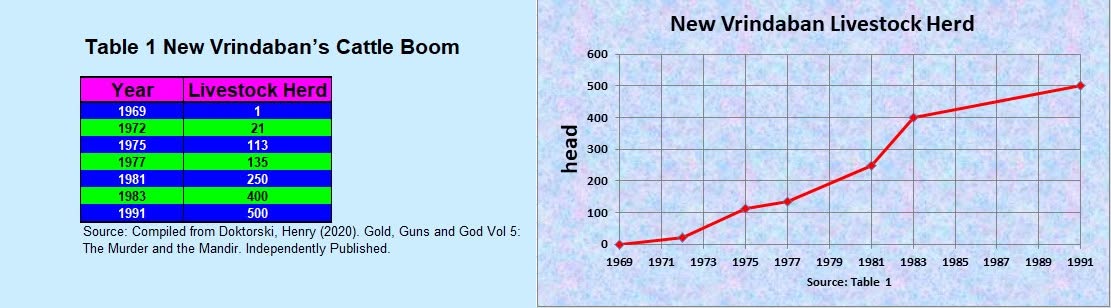
New Vrindaban is a prime example of what not to do. Kirtanananda dreamed of having the largest dairy farm in West Virginia, and for a time, that goal “clearly seemed to have become a reality” (GGG5 p. 137 Kindle Edition)—in 1991 the livestock herd reportedly expanded to 500 head (including cows, oxen, and bulls), up from 400 in 1983 (Table 1).However, Kirtanananda’s dream could not be sustained in the face of binding financial and land constraints, legal expenses, his insane obsession with building a magnificent Palace of Gold, and a few years later an enormous granite temple in South-Indian Dravidian style estimated to take fifteen years to construct.
𝐂𝐚𝐫𝐫𝐲𝐢𝐧𝐠 𝐂𝐚𝐩𝐚𝐜𝐢𝐭𝐲
New Vrindaban does not have the internal resources to maintain a large livestock herd. Based on New Vrindaban’s climate and soil, each cow requires about 6-10 acres of arable land, according to Madhava Gosh (ISCOWP News, 1998, Issue 1). The land requirement for a given herd, i.e. the carrying capacity, varies due to differences in local growing conditions, feeding practices, and the specific cow breed, e.g. Holstein versus Jersey cows. Carrying capacity falls sharply when the soil is not properly maintained. To avoid dramatic reductions in carrying capacity, lime must be applied to New Vrindaban’s naturally acidic soil, and pastureland must be rotated to avoid overgrazing.Although the exact extent of New Vrindaban’s carrying capacity may be debatable, the community’s farm managers did not even come close to properly incorporating land or even labor constraints into their decision-making. Please note the size of the agricultural labor force is also uncertain, as devotee farm hands can come and go. A great deal of New Vrindaban is forest, and not all of the non-forested land is arable. “…much of the land is too steep to be used even for grazing.” (Madhava Gosh, ISCOWP News, 1998, Issue 1) “Despite the community’s vast acreage, there was apparently not enough man power nor arable farmland to grow adequate feed for the animals. The goshala was not self sufficient; it could not survive without outside funding.” (GGG5, p. 137 Kindle Edition) [bold, mine]In a letter to Kirtanananda dated June 24, 1969, Srila Prabhupada had requested “…that you try and keep as many cows as possible in your New Vrindaban” (GGG5, p. 135, Kindle Edition). However, the key phrase is, “as possible.” The temple leaders must take responsibility for calculating what is possible. Krishna already provided—He provided humans with a brain and higher intelligence, and those blessings should not be thrown away. ISKCON was intended to be decentralized with local temples wielding considerable autonomy. Each temple should make practical decisions based on an understanding of local conditions and constraints.
𝐏𝐫𝐚𝐜𝐭𝐢𝐜𝐚𝐥 𝐎𝐛𝐬𝐭𝐚𝐜𝐥𝐞𝐬
But let us forget about ISKCON for a moment or two. After all, I am humbly suggesting that ISKCON devotees walk away from the cult institution and consider forming their own preaching centers if that is their calling. Let us assume that these new preaching centers are managed by honest and wise leaders who have resolved not to make the mistake of breeding cows for milk, as Kirtanananda did. Instead, the enlightened leaders will breed cows for draft power. Unfortunately, even with honest leadership and the correct breeding strategy, in the short run, it is difficult for devotee farms to effectively employ draft animals. In the United States, only the tiniest number of people have the ability and temperament for engaging oxen in agricultural tasks. The human ox-handler must first become friends with the oxen, which can take a considerable amount of time. After establishing friendship and rapport, the teamster must teach the oxen to follow voice commands, rather than cruelly using a nose ring. Bovines are perceptive beasts. They can sense human impatience, frustration, and anger. The oxen will react by becoming stubborn. Few people can work with oxen in a continually respectful manner, always remembering the ox represents Dharma. It is a truly rare individual who can simultaneously cherish and utilize draft animals in farming without worrying about their financial situation or survival. Ox handlers rarely operate in economic settings that permit them to compassionately work with their draft animals at a measured, humane pace. And do not forget the reality of carrying capacity. Each cow requires several acres of land, as discussed earlier. Land purchases can be costly—even more so when financed with mortgage loans which create an additional layer of risk. A cow can live 20-25 years, and she must receive care and support even in old age. Eventually, the Vaishnava community might be forced to ask for donations to support its aging cow population. In that case, the devotee farm is no longer self-reliant.
𝐏𝐫𝐞𝐥𝐢𝐦𝐢𝐧𝐚𝐫𝐲 𝐒𝐭𝐚𝐠𝐞
Economic reasoning dictates that agricultural development begins with vegan farms. One study suggests that an adult vegan requires less than one acre of land to be self-sufficient in food for one year (https://www.selfsufficienthomesteading.com/). Obviously, this figure should be treated as a rough estimate. Different people require different amounts of food. Growing conditions are less favorable in some locations. Some gardeners are more skilled than others and/or have greater access to appropriate farming technologies. If every member of the devotee community is engaged in agriculture, then oxen are not needed. A healthy adult would not need petroleum-powered machinery or oxen to cultivate an acre of land that has already been cleared of vines, bushes, weeds, etc. Older farm tools that have long since been abandoned are still useful in non-commercial farming.
𝐕𝐞𝐝𝐢𝐜 𝐕𝐢𝐥𝐥𝐚𝐠𝐞
However, a larger, more diverse community will require a class of teamsters that can work effectively with oxen. If the goal is to implement a varnashrama-dharma system, each farmer would need to support several non-farmers. That is to say, each farmer must be able to cultivate relatively large amounts of land to support the entire devotee village, and such agricultural productivity is only possible with the help of oxen. In a village setting, the advantages of cow protection are too compelling to ignore or forego. Draft animals can do a lot more than just tilling large areas and fertilizing the fields. Oxen can be engaged in hauling and transport, grinding seeds to produce oil, milling grain into flour, powering saws to cut wood for fuel, and operating water pumps. Interestingly enough, ox-driven electric generators also exist, although I recommend that the temples remain connected to the grid. It is easy to talk about all of the wonderful things that can be accomplished with male bovines, but nobody has the necessary skills to actually do them. Those skills can be learned. However, devotees, including Suresh Persaud, spend lots of time criticizing ISKCON while being slow to learn about the more technical aspects of agriculture.
𝐅𝐢𝐧𝐚𝐥 𝐑𝐞𝐦𝐚𝐫𝐤𝐬
If the goal is to start a vegan community in which each member is engaged in farming, then oxen are not necessary. Each devotee would cultivate relatively small vegetable plots using their own labor, without the need to produce surplus food for others. On the other hand, if the objective is to establish a Vedic Village, the farmers must be productive enough to produce surplus food to feed the rest of the community. Such agricultural productivity requires the use of oxen. Math and economics indicate that the varnashrama-dharma system cannot be separated from cow protection.